psychic_ui::GLFWSystemWindow Class Reference
#include <GLFWSystemWindow.hpp>
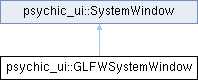
Inheritance diagram for psychic_ui::GLFWSystemWindow:
Classes | |
| struct | Callbacks |
Public Member Functions | |
| GLFWSystemWindow (std::shared_ptr< Window > window, GLFWwindow *glfwWindow) | |
| GLFWSystemWindow (const GLFWSystemWindow &)=delete | |
| GLFWSystemWindow & | operator= (const GLFWSystemWindow &)=delete |
| GLFWSystemWindow (GLFWSystemWindow &&)=delete | |
| GLFWSystemWindow & | operator= (GLFWSystemWindow &&)=delete |
| GLFWwindow * | glfwWindow () const |
| bool | render () override |
| GLProc | glProcAddress (const char *name) const override |
| void | setTitle (const std::string &title) override |
| void | setFullscreen (bool fullscreen) override |
| bool | getMinimized () const override |
| void | setMinimized (bool minimized) override |
| bool | getMaximized () const override |
| void | setMaximized (bool maximized) override |
| void | setVisible (bool visible) override |
| void | setCursor (Cursor cursor) override |
| void | startDrag () override |
| void | stopDrag () override |
| bool | supportsDrag () const override |
| void | wake () override |
| void | setSize (int width, int height) override |
| void | setPosition (int x, int y) override |
| std::string | getClipboardText () const override |
| void | setClipboardText (const std::string &text) override |
| Public Member Functions inherited from psychic_ui::SystemWindow | |
| SystemWindow (std::shared_ptr< Window > window) | |
| SystemWindow (const SystemWindow &)=delete | |
| SystemWindow & | operator= (const SystemWindow &)=delete |
| SystemWindow (SystemWindow &&)=delete | |
| SystemWindow & | operator= (SystemWindow &&)=delete |
| std::shared_ptr< Window > | window () const |
| bool | sharesContext () const |
| void | setSharesContext (bool sharesContext) |
| int | getX () const |
| int | getY () const |
| int | getWidth () const |
| int | getHeight () const |
| int | getFramebufferWidth () const |
| int | getFramebufferHeight () const |
| float | getPixelRatio () const |
| int | getSamples () const |
| int | getStencilBits () const |
| virtual std::chrono::nanoseconds | gestureTime () const |
| virtual ColorScheme | colorScheme () const |
| virtual void | startTextInput () |
| virtual void | stopTextInput () |
| virtual void | setTextInputArea (int x, int y, int width, int height, int cursor) |
Static Public Member Functions | |
| static Mod | mapMods (int mods) |
| static Key | mapKey (int key) |
Additional Inherited Members | |
| Public Types inherited from psychic_ui::SystemWindow | |
| using | GLProc = void (*)() |
| Protected Member Functions inherited from psychic_ui::SystemWindow | |
| void | detach () |
| void | readFramebufferFormat () |
| Protected Attributes inherited from psychic_ui::SystemWindow | |
| std::shared_ptr< Window > | _window |
| bool | _sharesContext {false} |
| bool | _dragging {false} |
| int | _stencilBits {8} |
| int | _samples {0} |
| float | _mouseX {0} |
| float | _mouseY {0} |
| int | _x {0} |
| int | _y {0} |
| int | _width {0} |
| int | _height {0} |
| int | _fbWidth {0} |
| int | _fbHeight {0} |
| bool | _focused {false} |
| bool | _minimized {false} |
| bool | _maximized {false} |
Detailed Description
Shows a Psychic UI Window in a GLFW window that a host application owns. The host initializes GLFW, creates the window with an OpenGL 3.3+ context and runs the loop; the adapter only installs its input callbacks over the host's, chaining to them, and draws on request:
GLFWwindow *glfwWindow = glfwCreateWindow(1280, 720, "Host", nullptr, nullptr);
glfwMakeContextCurrent(glfwWindow);
glfwSetKeyCallback(glfwWindow, hostKeyCallback);      // still called: the adapter chains to it

auto ui = std::make_shared<MyWindow>();
psychic_ui::GLFWSystemWindow adapter(ui, glfwWindow);

while (!glfwWindowShouldClose(glfwWindow)) {
    glfwPollEvents();
    adapter.render();                                   // makes the context current and draws
    glfwSwapBuffers(glfwWindow);
}
Install your own callbacks before creating the adapter: it calls the ones it replaces first, then handles the event. Destroy the adapter before the window: it puts those callbacks back.
Limits are GLFW's: no input method composition (characters arrive as typed), and on Wayland the window can't be moved from inside (supportsDrag() is false), so use system decorations there rather than a custom title bar. GLFW has no touch input either: the window stays in pointer mode, whatever the system makes of fingers, and the adapter never changes the mode, so a host with touch input of its own can hand it to Window::handleTouchPress and the others.
Member Function Documentation
◆ getClipboardText()
|
nodiscardoverridevirtual |
The system clipboard's text, in UTF-8. Without a system clipboard (this default), a clipboard that only lives in this system window.
Reimplemented from psychic_ui::SystemWindow.
◆ getMaximized()
|
nodiscardoverridevirtual |
Implements psychic_ui::SystemWindow.
◆ getMinimized()
|
nodiscardoverridevirtual |
Implements psychic_ui::SystemWindow.
◆ glProcAddress()
|
overridevirtual |
Address of an OpenGL function in this window's context, which Skia builds its GL interface from
Implements psychic_ui::SystemWindow.
◆ render()
|
overridevirtual |
Draws the window. When the window was closed from inside (a title bar's close button), marks the GLFW window as to be closed and returns false.
Implements psychic_ui::SystemWindow.
◆ setClipboardText()
|
overridevirtual |
Reimplemented from psychic_ui::SystemWindow.
◆ setCursor()
|
overridevirtual |
Implements psychic_ui::SystemWindow.
◆ setFullscreen()
|
overridevirtual |
Implements psychic_ui::SystemWindow.
◆ setMaximized()
|
overridevirtual |
Implements psychic_ui::SystemWindow.
◆ setMinimized()
|
overridevirtual |
Implements psychic_ui::SystemWindow.
◆ setPosition()
|
overridevirtual |
Implements psychic_ui::SystemWindow.
◆ setSize()
|
overridevirtual |
Implements psychic_ui::SystemWindow.
◆ setTitle()
|
overridevirtual |
Implements psychic_ui::SystemWindow.
◆ setVisible()
|
overridevirtual |
Implements psychic_ui::SystemWindow.
◆ startDrag()
|
overridevirtual |
Implements psychic_ui::SystemWindow.
◆ stopDrag()
|
overridevirtual |
Implements psychic_ui::SystemWindow.
◆ supportsDrag()
|
nodiscardoverridevirtual |
Whether the window can be moved from inside it, by Window::isDragArea or startDrag()
Reimplemented from psychic_ui::SystemWindow.
◆ wake()
|
overridevirtual |
glfwPostEmptyEvent, which ends a host's glfwWaitEvents: a host that waits draws when Window::untilNextFrame says so
Reimplemented from psychic_ui::SystemWindow.
The documentation for this class was generated from the following files:
- psychic-ui/applications/GLFWSystemWindow.hpp
- psychic-ui/applications/GLFWSystemWindow.cpp
Generated by
 1.17.0